Observation accounting
Counts distinguish recovered target-attributed rows, searched rows that were not recovered, pending states, and rows outside the selected search window.
Find past observations of asteroids and comets in archived survey data. Precovery propagates each object's orbit and uncertainty across a selected date range, identifies exposures that could contain it, and returns candidate detections with review diagnostics, available image products, and current MPC and Scout context.
Run Precovery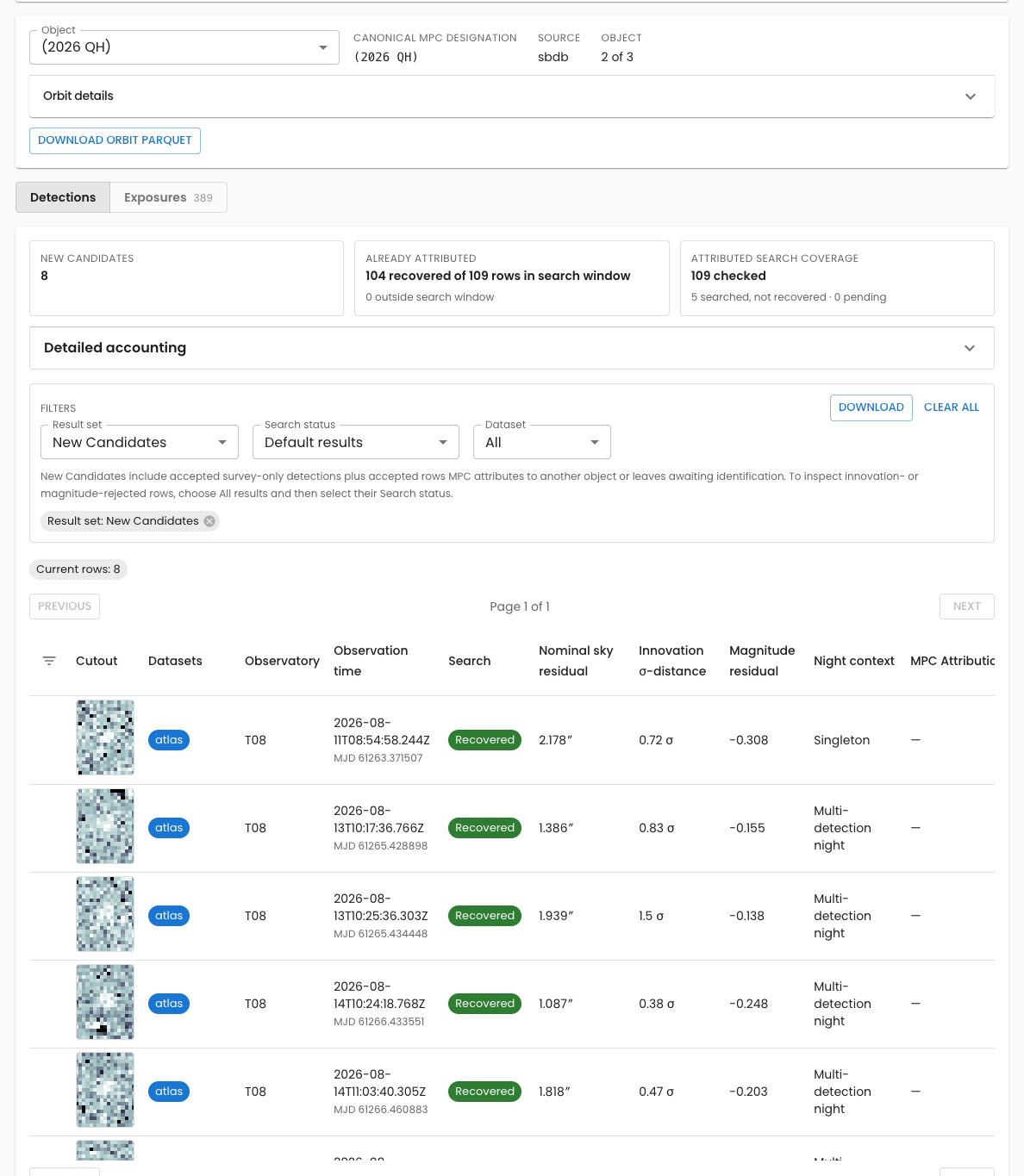
Precovery starts from an orbit and covariance obtained from JPL SBDB, ESA NEOCC, JPL Scout, or the Minor Planet Center. For each object, it propagates that state across the selected date range, predicts an uncertainty region on the sky at each epoch, and intersects the region with archived survey exposure footprints. It searches available detections in matching exposures, evaluates positional consistency and, when supported, magnitude criteria, then presents the rows with current MPC attribution and NEOCP or Scout context.
Searches run asynchronously. The result page reports progress and displays queryable results as they become available. See the Precovery methods page for the propagation, frame-selection, and detection-acceptance model.
Candidate rows require expert review and should not be submitted automatically to the Minor Planet Center.
Each result reports how many target-attributed observations were recovered, which candidate detections were found, and the evidence available for reviewing each row.
Counts distinguish recovered target-attributed rows, searched rows that were not recovered, pending states, and rows outside the selected search window.
Rows include survey, observatory, time, search status, astrometric residuals, innovation distance, magnitude, MPC attribution, and NEOCP or Scout state.
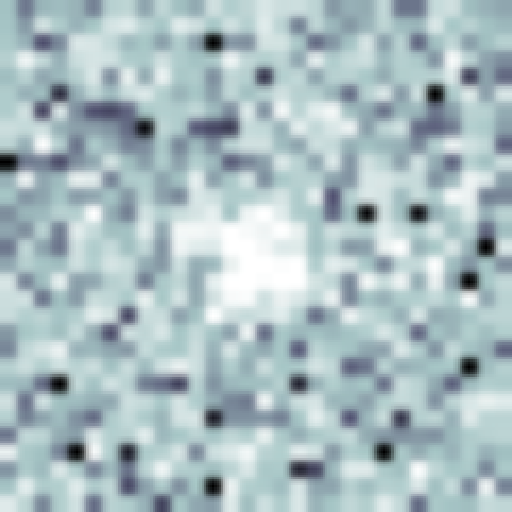
Available image products show measured and predicted positions. Orbit provenance, ADES PSV exports, and adam-core SourceCatalog exports support independent review and follow-up analysis.
Browse read-only Precovery results for 3 real objects. No account is required. Each page shows recovered attributed observations, candidate detections, row-level diagnostics, and available survey images in the Precovery result interface.
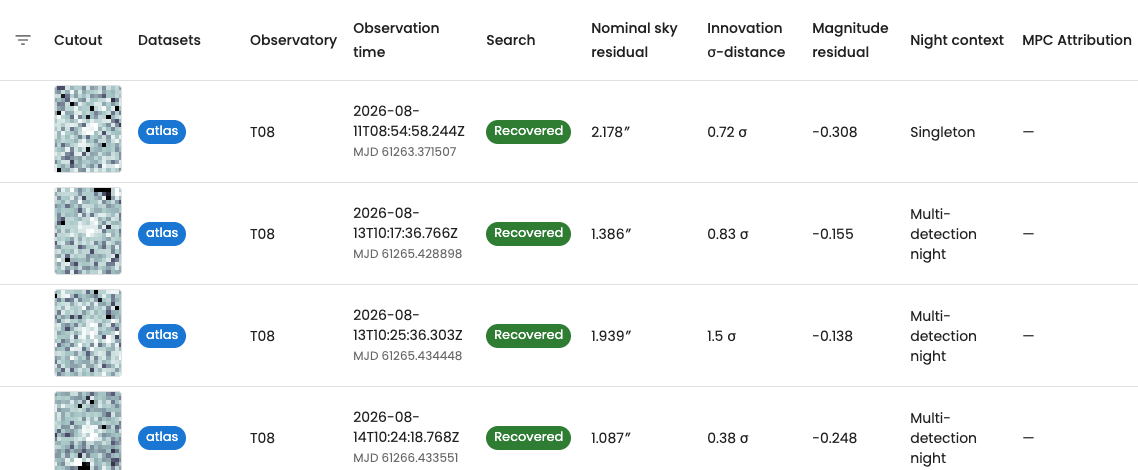
Eight accepted ATLAS candidate rows. Precovery recovered 104 of 109 target-attributed rows in the search window.

Four accepted Rubin candidate rows from one night. Precovery recovered all 21 target-attributed rows.
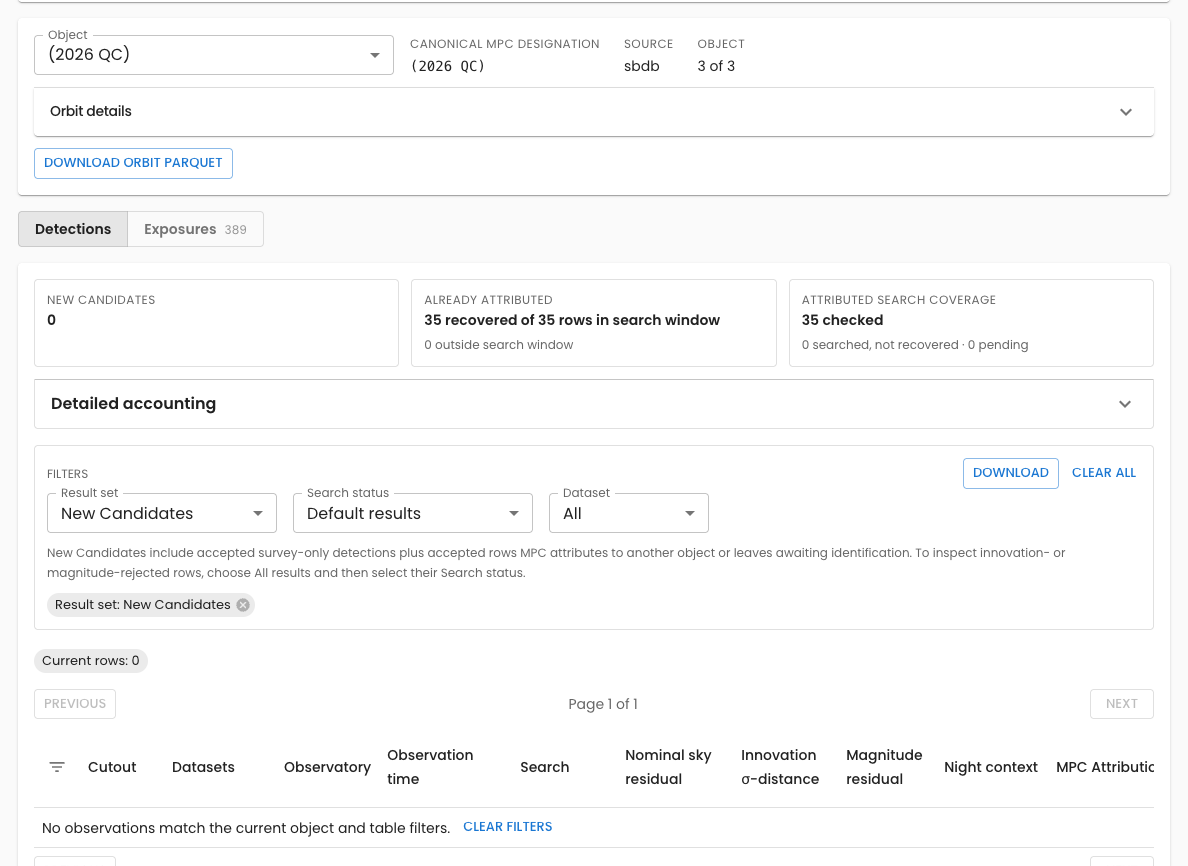
No candidate rows. Precovery recovered all 35 target-attributed rows and reports the empty candidate set explicitly.
Search dates can range from 1962-01-20 through 2099-08-27. The catalog window begins on 2012-09-01; the earliest survey detections in the current inventory are NSC observations from 2012-09-23.
The current image-search catalog contains five survey datasets across ten mapped MPC observatory codes. Published MPC astrometry is included as a sixth, non-image dataset.
atlas
ATLAS survey telescopes at Mauna Loa (T08), Haleakalā (T05), South Africa (M22), and Chile (W68).
Catalog coverage: 2015-06-18 onward.
ztf
Samuel Oschin Telescope at Palomar Observatory (I41).
Catalog coverage: 2018-06-01 onward.
nsc
Blanco/DECam at CTIO (W84), Bok/90Prime (V00), and Mayall/Mosaic3 at Kitt Peak (695).
Catalog coverage: 2012-09-23 through 2019-11-16.
skymapper
SkyMapper telescope at Siding Spring Observatory (Q55).
Catalog coverage: 2014-03-15 through 2018-03-31.
lsst
Simonyi Survey Telescope at Vera C. Rubin Observatory (X05).
Catalog coverage: default start 2025-09-01; continuing.
mpc
Published astrometry from the worldwide MPC station network. This is a non-image reference dataset used for recovery and attribution accounting, not a single telescope archive.
See AIMS data provenance for source-specific access, selection, normalization, and limitations.
Sign in to search for one or more asteroid or comet designations using an orbit from JPL SBDB, ESA NEOCC, JPL Scout, or the MPC.
Run Precovery