Ephemeris Service
Generate ephemerides for asteroids and comets across many observers and epochs. Compute sky positions, apparent magnitudes, rates of motion, and observability metrics for survey planning, follow-up observations, and pipeline workflows.
How It Works
The Ephemeris Service uses ASSIST, a high-fidelity N-body integrator, to propagate input orbits to requested epochs. Observer positions are computed from SPICE kernels for topocentric or spacecraft-relative ephemerides. ADAM returns sky positions, rates of motion, magnitude estimates where available, and observability quantities in formats designed for research and pipeline use.
🛰 Observation Ready: Ephemerides turn orbit solutions into actionable observing plans, helping teams identify when and where targets are observable and how they will move across the sky.
Video Guide
Watch a quick overview of ADAM::Ephemeris Service.
Key Capabilities
An ephemeris engine backed by high-fidelity N-body propagation, serving both survey planning and follow-up observation workflows.
Rate of Motion
Output includes RA and Dec rates in arcsec/hr, including cos(dec)-corrected RA rate. Useful for planning telescope tracking, exposure times, and streak detection.
Observability Metrics
Every output row includes solar elongation, Moon-target angular separation, and approximate altitude/azimuth for ground-based sites, enabling filtering for observable windows.
Predicted Magnitudes
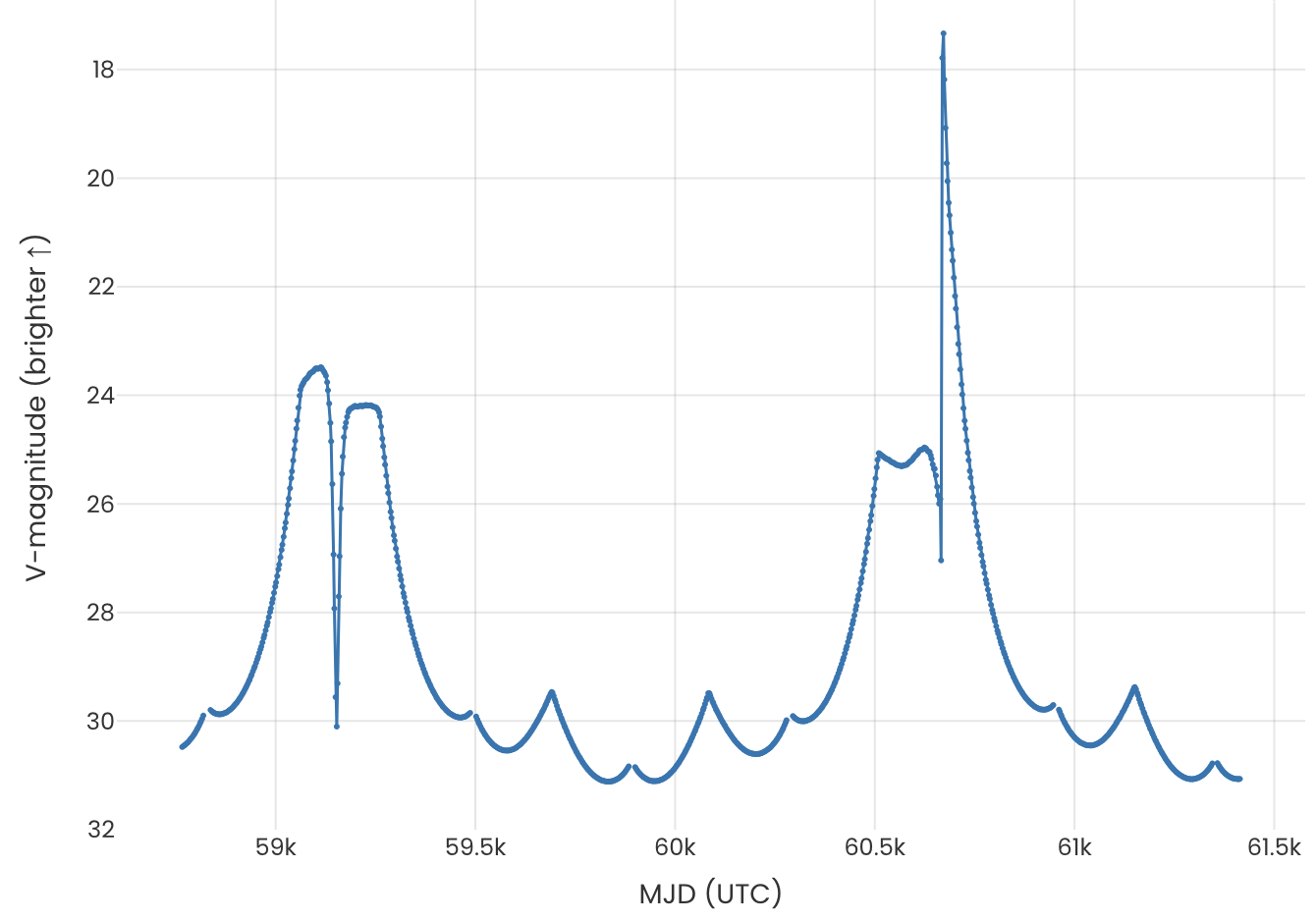
Estimate apparent visual magnitude where supported, using available photometric parameters from the input orbits and accounting for heliocentric distance, observer distance, and phase angle.
Supported Observers
Compute ephemerides from many vantage points in the solar system.
- MPC observatory codes — search by code or name with autocomplete.
- NAIF reference points — geocenters, barycenters, planet centers, and major moons.
- Spacecraft observers — JWST, HST, and TESS, computed from SPICE kernels where coverage is available.
Output Formats
Choose the format that fits your workflow.
- Apache Parquet —
adam_core.orbits.Ephemerisschema with efficient columnar compression. Load withEphemeris.from_parquet(). - CSV — flat table with one row per observation point. Compatible with any spreadsheet or data tool.
- ADES-style PSV — pipe-separated values with metadata marking rows as computed ephemerides.
Need implementation details? See the adam_core documentation for supported input formats, observer definitions, output fields, and model assumptions.
Interactive Demo Examples
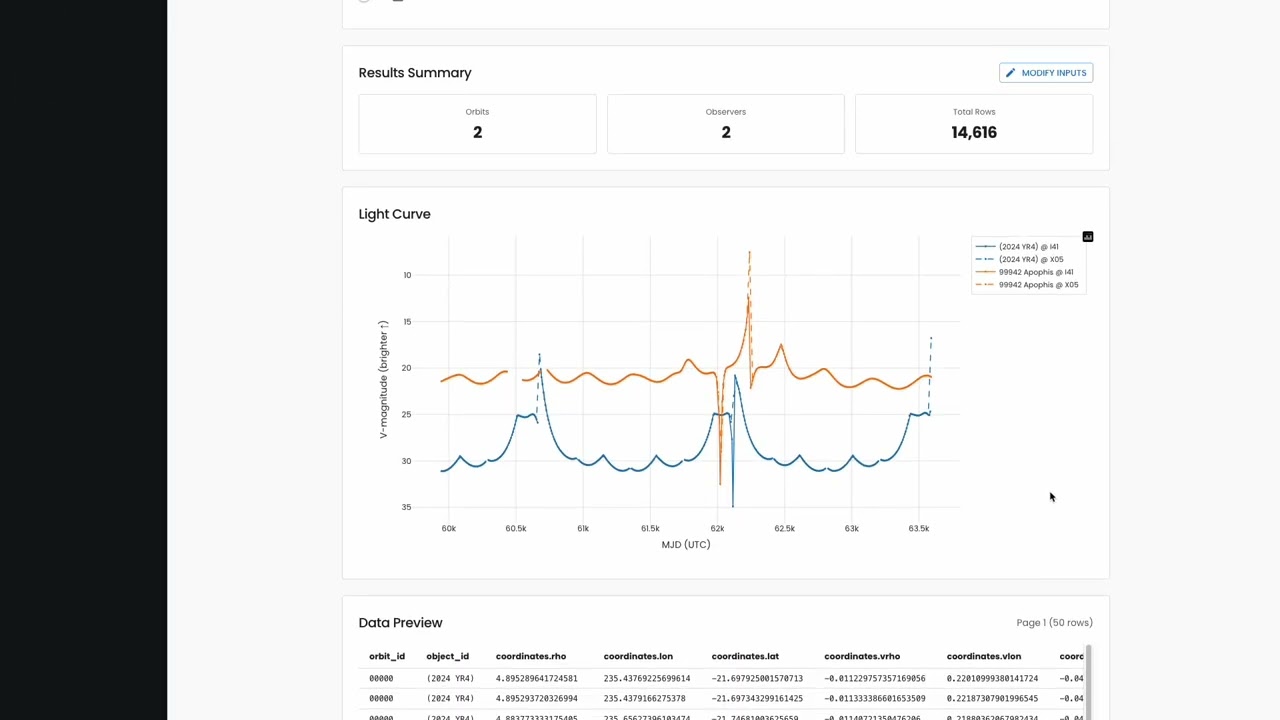
Explore real ephemeris results across different observers and epochs. Each demo shows full results with interactive plots and downloadable data.
Apophis — 2029 Close Approach
Sky positions, rates, and observability metrics for (99942) Apophis from major ground sites through its April 2029 Earth flyby.
2024 YR4 — Multi-Site Ephemeris
Predicted positions and magnitudes for 2024 YR4 across a network of MPC observatories during its follow-up window.
More demos coming soon.
Ready to Compute Ephemerides?
Start generating sky positions for your targets. Create an account to access the full ADAM platform.
Create Your Account